


Seasoned real estate investors know what to do with different types of properties, whether it’s an apartment complex, a single-family home, or a business complex. There are only so many plays to run.
Owning land, on the other hand, requires some vision and creativity. So, if you find yourself sitting on an acre of land, you may ask yourself: how do you make it profitable (so profitable that it pays for itself)?
Here are the best ways real estate investors can profit from land ownership and generate extra income.
First, How Big Is an Acre?
Before we jump in, I want you to visualize how big an acre of land is. Chances are, it’s either bigger or smaller than you expect. An acre is 43,560 square feet, roughly the size of a football field (minus the end zones). While it’s not big enough land for grazing animals, it is big enough for a farmer’s market!
Next, How Much Does an Acre Cost to Buy?
If you don’t already own land, you may be considering purchasing an acre (or two) with the intent of transforming it into a relatively passive income stream.
(With the right strategy, you can make land pay for itself).
But how much will it cost you? Here are the prices you can expect in these 10 top US markets.
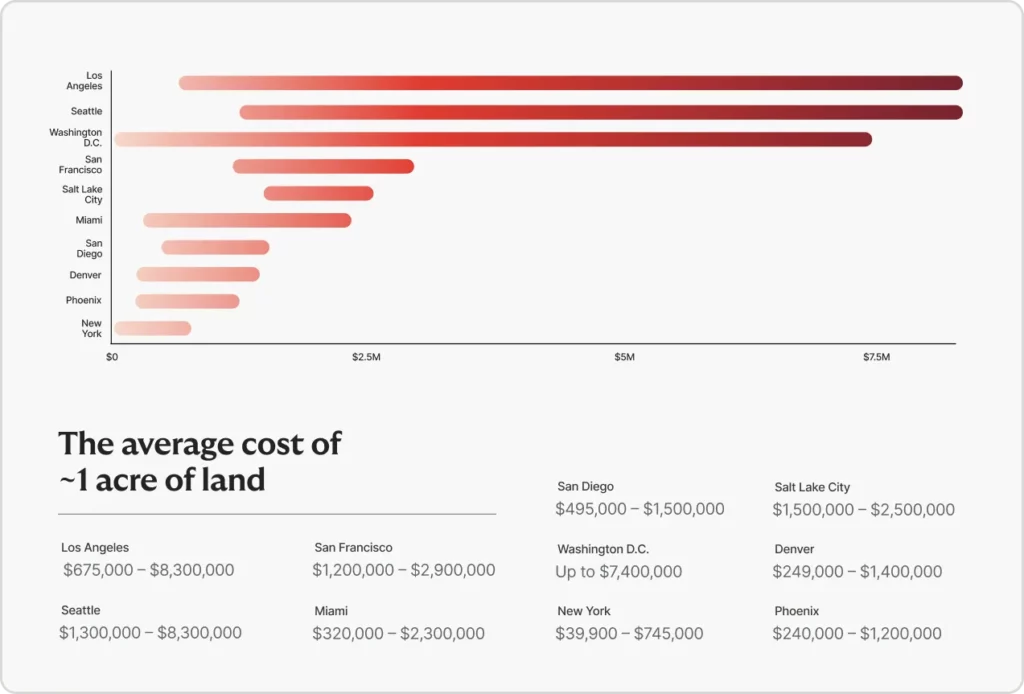
With a better idea of how much the land itself will cost you, you can gauge the amount of revenue you’ll need to generate (per month or per year) before your land officially pays for itself.
But wait! You’ll need to recoup more than just the purchase price. The income generated will also need to cover the hidden costs of land ownership.
Check out the infographic below for more insight into these hidden costs:

Once you’ve calculated these costs, it’s time to decide which money-making opportunity is right for you.
Option #1: Start an RV Storage Lot (Low Effort, High Profitability)
Depending on your land and location, RV Storage is an incredibly lucrative opportunity and a great way to earn [relatively] passive income. Both during and after the pandemic, RV sales have soared while available storage options have shrunk (as one might expect, when demand increases, supply decreases proportionately).
Overall, I think an RV storage business is such a great opportunity because you don’t need to invest a ton to get started. At a minimum, you need a gate, an open area free of hazards, and a way for tenants to get their vehicles in and out easily enough.
As you might expect, the more vehicles you can store, the more income you can make. So, consult this guide to calculate the number of RV storage spots you can fit per acre.
Pros
- Low starting costs: You don’t need to do much to the land to start storing RV’s
- Monthly recurring revenue: Most people are looking for long-term storage, which means you get to collect consistent monthly revenue.
- Recession-proof: So many people are looking for storage (RV storage and otherwise), even in financially precarious times.
Challenges
- Zoning: Zoning laws might prohibit this opportunity.
- Limited space: With only an acre, you can only store so many RVs (especially if your renters are storing large fifth wheels and travel trailers).
Cost
- Fencing and Security: Chain-link fencing costs $5,000-$15,000, while adding an automatic gate and cameras will range anywhere from $4,500-$12,000.
- Ground Preparation: Grading and gravel cost $1,500-$5,000. Paving is optional and costs $10,000-$25,000.
- Maintenance: Landscaping and debris removal cost $500-$1,500 annually.
- Insurance: Liability coverage is essential and costs $1,000-$3,000 annually.
Revenue Potential
An RV storage lot can generate steady income with minimal effort after setup. Assume that you could accommodate 20-40 RVs in a single acre, depending on layout and local regulations. With average monthly rental fees ranging from $50 to $150 per RV, you could earn $1,000-$6,000 monthly or $12,000-$72,000 annually.
Option #2: List Your RV Storage Spaces on Neighbor (Low Effort, Medium Profitability)
Once you’ve mapped out the rentable space and configured the necessary driveways and aisleways, it’s time to fill those spaces. Neighbor is a peer-to-peer service that can match you with qualified renters looking for a reliable place to store their RV.
Just list your space, approve renters, and collect revenue. The best part is that Neighbor will take care of payment collection (They’ll even guarantee the payment, so you receive compensation even if the renter doesn’t pay their monthly rental fees).
Option #3: Create a Glamping Retreat (Medium Effort, High Profitability)
Setting up a glamping retreat on your land attracts travelers looking for a unique getaway. All you need to start is a few well-designed tents, yurts, or small cabins, as well as some basic amenities like running water and electricity.
The key here is to create an immersive experience that stands out from all the other Airbnbs vying for travelers’ attention.
Pros
- High earning potential: Glamping sites can command premium nightly rates.
- Flexibility: You can start small with one or two structures and expand over time.
- Appealing to eco-conscious travelers: Sustainable and nature-based tourism is on the rise.
Challenges
- Infrastructure investment: Most land doesn’t have running water or electricity, so you’ll be looking to spend a good deal of money just to get the basics.
- Maintenance: Keeping the site clean and appealing is ongoing work that will translate to ongoing monthly costs.
- Seasonality: Demand may drop in colder or hotter months, depending on your location.
Cost
- Structures: Glamping tents, yurts, or tiny cabins can cost $2,000-$15,000 each, depending on style and size.
- Utilities: Installing running water, electricity, and septic systems could range from $10,000-$50,000, depending on your land’s existing infrastructure.
- Landscaping: To create a visually appealing and functional space, prepare to spend anywhere from $2,000-$8,000–which will cover the cost of pathways, outdoor seating, fire pits, and lighting.
- Furnishings: To provide a luxurious experience, budget $1,000-$5,000 per unit for beds, linens, and decorative items.
- Marketing: Building a website, social media campaigns, and listings on platforms like Hipcamp or Airbnb can cost $500-$2,000 upfront, not accounting for ongoing fees.
Revenue Potential
With nightly rates of $75-$250 per unit, even a small operation with 3-5 units could bring in $6,750-$37,500 monthly at full occupancy. Annual earnings could range from $81,000 to over $450,000, depending on pricing, demand, and seasonal factors.
Option #4: Rent Land for Food Trucks or Farmer’s Markets (High Effort, High Profitability)
If your acre is near a busy area, renting space to food trucks or local vendors can be lucrative. Hosting a regular farmer’s market can attract both sellers and customers, turning your property into a community hub.
Pros
- High foot traffic: Food trucks and markets draw regular crowds.
- Minimal investment: Vendors bring their own equipment and infrastructure.
Challenges
- Zoning and permits: Running commercial events may require local approval.
- Seasonal demand: Outdoor markets may slow down in colder months.
- Parking space: You’ll need enough room for both vendors and customers, so if you’re space-constrained, this may not be the right opportunity for you.
Cost
- Permits and licensing: Depending on your location, you may spend $500-$2,000 to obtain necessary permits.
- Site preparation: Gravel for parking areas, trash bins, and basic landscaping may cost $2,000-$5,000.
- Utilities: Providing water or electricity hookups for vendors could add an additional $1,000-$3,000 to your monthly expenses.
- Maintenance costs: Trash removal, regular cleanup, and occasional repairs could cost $200-$500 monthly.
- Marketing: Flyers, social media ads, or local promotions to attract vendors and customers may require $200-$1,000 upfront.
Revenue Potential
Renting space to food truck owners or hosting farmers’ markets can generate consistent income. When you charge a vendor $25-$100 per event and host an average of 10-20 vendors weekly, you could bring in $1,000-$8,000 monthly or $12,000-$96,000 annually.
Option #5: Open a Dog Park (Low Effort, Medium Profitability)
Dog parks are in demand. Regardless of the market conditions, people will continue to own pets, even in areas where large yards are rare and access to open spaces is limited.
The solution to meeting demand is simple. Throw in some secure fencing, plants, and shaded areas, and you can create a safe and enjoyable environment for dogs and their owners.
Pros
- Recurring revenue potential. Charge a small membership fee or daily entry fee for consistent income.
- Community demand. Pet owners want safe, off-leash areas for their dogs to play. Demand will stay consistent year-round, regardless of market.
- Moderate startup costs. A simple layout with fencing, water stations, and seating is enough to get started.
Challenges
- Liability concerns. You’ll need insurance to cover potential accidents or disputes, which can be costly.
- Ongoing maintenance. Regular cleanup, landscaping, and repairs are crucial for keeping the park safe and attractive. Ongoing maintenance = ongoing costs.
- Space limitations. With just one acre, the number of dogs that can use your facilities at one time will be limited.
Cost
- Fencing: Secure fencing is essential and will likely cost $5,000-$12,000, depending on the material and layout.
- Amenities: Water stations, benches, and shaded areas range from $2,000-$5,000. Waste disposal stations and signage add another $500-$1,000.
- Insurance: Liability coverage to protect against accidents costs $1,000-$3,000 annually.
- Land Preparation: Grading, gravel, or grass enhancements can range from $1,500-$4,000, depending on the condition of the land.
- Marketing: Advertising locally or on social media to attract members may cost $100-$500 per month.
- Maintenance Costs: Ongoing cleanup, landscaping, and waste management will cost $500-$2,000 annually.
Revenue Potential
A well-maintained dog park can generate reliable income through memberships or daily entry fees. Charging $5-$10 per visit or $30-$100 monthly for memberships could yield $1,000-$5,000 monthly or $12,000-$60,000 annually, assuming consistent attendance.
Option #6: Create a Community Garden (Medium Effort, Medium Profitability)
Transforming your land into a garden is a neat way to generate income. Earning potential aside, you’ll also be able to foster connections with your neighbors and friends.
By dividing your land into plots for gardeners to grow plants, flowers, or other crops, you can provide an attractive service for people who lack gardening space.
Pros
- Community-focused: People are naturally skeptical about new developments in their area–but just about everybody loves a garden! The sense of community created often leads to higher retention and consistent participation.
- Recurring revenue: Renting plots generates consistent income with minimal effort on your part (you’re not the one who needs the green thumb).
- Flexible use: Facilitates the growth of diverse plants, including flowers, herbs, and specialty crops like microgreens.
Challenges
- Maintenance: Although participants are responsible for their plots, you’ll be on the books to manage common areas, enforce rules, and handle water access.
- Liability: You may need insurance to cover potential accidents or disputes.
- Zoning restrictions: Check local laws to ensure using your land for a garden is allowed.
Cost
- Fencing and access control: Secure fencing can cost $1,000-$3,000 to protect the garden from animals or vandalism.
- Water infrastructure: Installing a shared water system or hose connections might cost $500-$2,500 upfront, depending on the size of the area.
- Garden setup: Raised beds, compost bins, and pathways could range from $500-$1,500, depending on whether you DIY or hire professionals.
- Ongoing costs: Expect maintenance costs for water, repairs, and general upkeep to be around $200-$500 annually.
Revenue Potential
Community gardens generate recurring income through plot rentals. Renting 20-40 plots at $20-$50 monthly can bring in $400-$2,000 monthly or $4,800-$24,000 annually. Additional income from selling your produce or offering gardening workshops could increase these earnings.
Option #7: Growing Crops (High Effort, Low Profitability)
Not everyone has a green thumb, but for some land owners, growing valuable crops can be a profitable venture if done strategically.
Specialty produce, herbs, or flowers can fetch high prices at local markets or through direct-to-consumer sales. Examples include lavender, saffron, heirloom vegetables, or medicinal herbs like ginseng.
Pros
- High earning potential: Saffron or lavender can command premium prices compared to others.
- Multiple uses: You can farm raw produce, value-added products (like lavender oil), or seeds.
- Community ties: Selling at farmers’ markets fosters connections with your neighbors and builds local demand.
- Seasonal flexibility: Some can be grown and sold year-round in the right conditions.
Challenges
- Labor-intensive: Farming is tough. Planting, harvesting, and processing require significant time, effort, and other resources (including financial ones).
- Seasonality risks: Weather or pests can heavily impact your harvest, putting you at the mercy of Mother Nature.
- Market competition: Requires strategic marketing to stand out.
- Space limitations: With one acre, your output will be modest, so you’ll need to maximize efficiency to render a decent ROI.
Cost Breakdown
- Seeds or starters: Lavender or saffron bulbs can cost $500-$2,000 to start.
- Land preparation: Tilling, fertilizing, and irrigation setup may cost $1,000-$3,000.
- Maintenance costs: Fertilizers, pest control, and labor can add up to $500-$1,500 annually.
- Marketing: Selling directly to consumers might require an investment of $200-$1,000 for packaging, signage, or online promotion.
Revenue Potential
Growing lavender on an acre can yield hundreds of pounds of flowers, with potential profits of $5,000-$15,000 annually, depending on the product (raw lavender, oils, or sachets). With flowers like lavender or saffron, a small area can make a big impact if managed well.
Option #8: Install Solar Panels (Low Effort, Medium Profitability)
Turning your acre into a solar farm can provide consistent, passive income while contributing to clean energy production. You can sell the electricity back to the utility company or use it to offset costs on your property.
Pros
- Passive income: After installation, the panels generate revenue with minimal effort.
- Environmentally friendly: Contribute to renewable energy production and reduce your carbon footprint.
- Government incentives: Tax credits, grants, and subsidies can significantly reduce installation costs.
- Low maintenance: Solar panels require minimal upkeep beyond periodic cleaning.
Challenges
- High upfront costs: Installing panels can require a large initial investment.
- Zoning and permits: You’ll need approval to install them. Policies and procedures will vary by location.
- Land limitations: With one acre, you may not produce enough electricity to generate substantial income.
Cost
- Equipment and installation: Costs typically range from $15,000–$30,000 per acre, depending on the system size and quality.
- Permits and approvals: Zoning permits may cost $500–$2,000.
- Maintenance costs: Expect to spend $100–$300 annually for cleaning and minor repairs.
- Grid connection fees: If selling electricity back to the grid, you may need to pay setup fees ranging from $1,000–$5,000.
Revenue Potential
A one-acre solar farm can generate around 40,000 kWh annually, earning $4,000–$8,000 per year, depending on local electricity rates.
Conclusion
As cliche as it sounds, the possibilities are endless. If you’re creative enough (and willing to try new things), you can find several profitable ways to use your land. So, if you find yourself sitting on some extra land or are thinking of buying empty land – I think it’s a good idea!